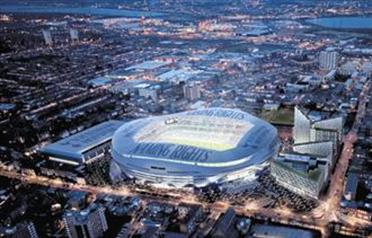
Club officials from Tottenham Hotspur will return to the region in the coming weeks with their custom-made Arabic business cards and translated brochures. And while the calligraphy may be incomprehensible to the travelling delegation, the message that such concerted efforts convey to prospective partners is explicit. Spurs have turned on the charm offensive as they search for a Middle Eastern backer to purchase the naming rights to the club's new £390m (Dh2.1 bn) stadium. The Northumberland Development Project – which, as well as featuring a 58,000-seat stadium, also includes shops, restaurants, residential properties and a hotel – will be built on a site adjacent to the North London club's current home, White Hart Lane. Executive Director Paul Barber led the delegation to Bahrain, Qatar and the UAE last week and will likely visit again later this month after attracting "phenomenal interest" from several wealthy Middle Eastern companies. But Spurs' sojourn was not simply to send out feelers; the club is also keen to assess the state of play in the Gulf, says Barber. "We have been making a lot of time to meet people in the region," he tells Emirates Business , shortly before speaking with representatives from Dubai-based Al Ahly Football Club. "We are very conscious of not walking into a country and expecting people to roll over and write nice, big cheques because we are a Premier League club. As nice as that would be, we are very realistic and know that's not how business is done here. "We're not naïve. We will run down many blind alleys because that's the nature of any kind of business transaction of this size." The scale of the deal is likely to vary depending on the company's industry and its proposed means of funding the project. But with Spurs also looking for a shirt sponsor, an agreement similar in structure to that of rivals Arsenal could be a posssibility. Tottenham's North London neighbours signed a 15-year contract with Emirates in 2004, with the Dubai-based airline's £100m outlay securing the naming rights to the club's new stadium, as well as seeing their brand emblazoned across the Arsenal shirt for eight years. In a recent brand awareness research project, the carrier came out as the No1 sports sponsoring airline in 13 of the 23 countries surveyed. Boutros Boutros, Emirates' Divisional Senior Vice President, Corporate Communications, says part of that perception is undoubtedly down to the airline's relationship with the London club. "There is no doubt that the partnership with Arsenal has helped us in some way to become established as a global brand," says Boutros. "I am sure the branding of the Emirates Stadium, along with all of our other promotional and advertising activities, helps to increase awareness and drive sales." Boutros adds that, as well as having seen very healthy bookings from the UK, ongoing research into the impact the stadium naming rights deal is worth shows a yearly return of more than £30m in advertising value. Ironically, Tottenham hope to use such figures as a bargaining tool to strike a long-term deal with proposed partners. Each flight into London's Heathrow Airport from Asia, before looping back on to the runway, flies directly over the site submitted for Spurs' new project. "We are talking about the only stadium naming rights deal to be done in the UK – certainly in London – in the next decade," says Barber. "The [planned] Olympic Stadium can't be sponsored and there is no other club in London – Chelsea included – who have got plans this far advanced, so we are in quite a unique position. This is a massive sponsorship deal and I think that has excited a few people in the region." Any potential Middle East partner, by having their brand broadcast to 211 countries throughout the year, is perfectly positioned to become a global brand. And that, according to Barber, is why Tottenham are focusing on the GCC and Asia. "The Coca-Colas, the Chryslers, the Pepsis, the Kodaks, the IBMs, the Yahoos; they are already internationally famous," he says. "They don't need to name a stadium in London to become famous. "Whereas, if you look to this region and the Far East, there are huge companies that are domestically focused or regionally focused and have massive international ambitions. "They could either spend £300-£400m on TV advertising around the world or they can become involved in the Premier League and get their share of 90,000 hours of programming a year. "When you look at the figures like that, it makes the sums we are looking at seem very small." It is unsurprising then that several Middle Eastern companies have already enquired about a potential investment in the Premier League. The UAE's Zabeel Investments, Dubai International Capital and Leisurecorp have all assessed the accounts of different top-flight clubs in recent months, while the Bahraini government's holding arm, Mumtalakat, has also shown an interest in the past. The risks involved in stadium naming rights d