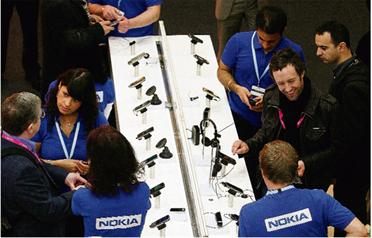
Nokia Oyj, the world's largest mobile-phone company, may be losing smartphone customers by failing to come up with applications and designs to take on Apple Inc, analysts say. Nokia plunged the most in more than five years yesterday, shaving $8.6 billion (Dh31.5bn) off its market value, after lowering targets for market share and profit margins. "This is a very tough spot for Nokia to be in right now," says Colin Gillis, a senior analyst at Brigantine Advisors in New York. "They're going to need the types of devices that people can use to download applications and the kind of devices that people can be interactive with, the types of devices we're seeing out of Apple." Nokia's share of the smart-phone market was 41 per cent in the second quarter, down from 62 per cent in 2005. Nokia estimates its overall market share was 38 per cent in the period, down from 40 per cent a year earlier. The overall share will slightly change this year, compared with a previous forecast of an increase, the Espoo, Finland-based company said this week. Instead of building a single flagship device such as Apple's iPhone, Nokia has multiple smartphone lines like the E Series and N Series, as well as music phones. That approach makes it difficult to attract software developers, who prefer to write programmes for a single platform with a large user base such as the iPhone than tailor their applications for a variety of handsets, says Mark McKechnie from Broadpoint Amtech Inc. "They do need to figure something out to keep themselves relevant for users," the San Francisco-based analyst adds. "The smartphone is critical to maintain a lead in the overall handheld market." The operating margin in the main devices and services division will be little changed in the second half from the first, when it was 11.3 per cent. Nokia earlier predicted the margin would be in the 'teens'. Nokia plunged €1.63, or 15 per cent, to €9.47 in Helsinki on Thursday, the most since April 2004. Before that, the stock was little changed for the year. Nokia won't return to its days of 40 per cent share of the overall mobile-phone market and 20 per cent operating profit margins, says McKechnie, who rates Nokia shares 'neutral'. Nokia anticipates the global handset market will shrink about 10 per cent in 2009 because of slumping economies and consumer spending. The market for smart phones, which can run computer-like applications, is the industry's fastest-growing segment, according to researcher Gartner Inc. "Competition is increasing in the smartphone area as many participants rush into one of the few growing markets," said Chief Executive Officer Olli-Pekka Kallasvu on a conference call with analysts on Thursday. Those rivals include Palm Inc, which last month started selling its Pre model and opened its App Catalog. Research In Motion Ltd, the maker of the BlackBerry smart phones, and Samsung Electronics have also opened applications stores. Another dominant software player making inroads in the market is Microsoft Corp, whose Windows Mobile operating system works on Samsung, Sony Ericsson Mobile Communications and HTC Corp phones. Google is also aiming for a share of the pie with its Android mobile operating system. Nokia has been under siege before. Its global market share fell to the lowest in five years in 2004 as customers picked clamshell phones made by Motorola, Samsung and Sony Ericsson, a trend Nokia had discounted. Nokia fought back with clamshell models, clawing back market share and reaching 40 per cent in 2007. The Finnish company began to refresh its smart phones last month with the N97, which combines a touch screen and a snap-out keyboard. The device sold 500,000 units in June, Kallasvuo said. Cupertino, California-based Apple sold more than one million units of its latest model, the iPhone 3G S, in the first three days of its debut last month. Software downloads also have attracted Nokia management's attention. Ramping up the online Ovi Store for applications is central to Kallasvuo's vision of Nokia becoming a software provider that continuously gets revenue from customers, and not just every few years when they buy a new mobile phone. Nokia's share of worldwide smartphone sales fell to 41.2 per cent in the first quarter from 45.1 per cent a year earlier, according to Gartner, while Apple's doubled to 10.8 per cent. Nokia shipped 103.2 million phones in the quarter, a 15 per cent drop from a year earlier, while its smartphone sales increased 10 per cent to 16.9m units. Second-quarter net income at Nokia fell to €380m from €1.1bn a year earlier, while revenue slid 25 per cent to €9.9bn. "Nokia is way ahead in all regions of the world, except the USA, where it is being battered by Apple and BlackBerry," says Neil Mawston, a director at researcher Strategy Analytics Ltd in Milton Keynes, England. "The USA is now the world's most important smartphone market and Nokia urgently needs to recover in that region if it is to be taken seriously as a mo