Free-market key to Sharjah's growth
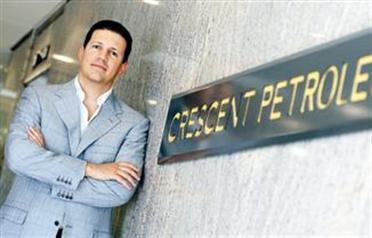
Eton and Harvard-educated, Majid Jafar could have gone on to reach the pinnacle of success on Wall Street or the City of London – maybe even both. Yet, his roots are deeply implanted in the UAE, both in terms of culture and family.
Among the leading group of second generation businessmen in the Emirates, Jafar, in his early 30s, is helping to ensure Crescent Petroleum, the company his father started more than three decades ago, remains on its successful trajectory. Emirates Business caught up with him to discuss oil prices, the current financial crisis and his respect and appreciation of the emirate of Sharjah where his commercial interests are based.
From your point of view, as a Sharjah businessman, how have you seen the impact of the development of the Emirates' economy?
Sharjah is the third largest economy in the UAE, and one of the most diverse, and has the widest industrial base in the UAE with many SMEs, several successful free trade zones, and world-class ports on both coasts.
The approach of the government has been very free-market oriented, encouraging the private sector and with hardly any state-owned companies in any sector. As examples – there are local private sector companies in the oil and gas sector, port management, oil products, hotel management, and Sharjah is also home to Air Arabia, the first airline in the Middle East to be publicly listed. At the same time, and although Sharjah has also experienced phenomenal economic growth in recent years, the emphasis has not just been on growth but on social and educational development and quality of life, with top quality universities such as the American University of Sharjah, cultural activities, and 25 museums.
I must take this opportunity to highlight the world-renowned Sharjah Biennial Art Fair, which is currently on and which we as Crescent Petroleum are proud to be sponsoring.
How is the current economic downturn affecting Sharjah. Are the consequences of the slowdown different than those being felt in Dubai and the rest of the UAE?
Of course, no economy on earth has been spared by the global downturn, but in Sharjah some of the effects have been less severe, mainly because the exposure to real estate was much less.
The economy, trade and identity of Sharjah has been more regional and linked to the Arab world, and the proportion of expats is a bit lower. As such there was not much speculation in property investment or major freehold developments.
How dependent is Sharjah on the economic growth in Dubai?
All the economies of the UAE are interdependent and yet all of them choose slightly different models for development and emphasise different aspects. This is in my view the key to the success, resilience and diversification of the UAE economy – the federal system has allowed a larger number of companies, positive competition, and a higher quality of goods and services, leading to the second largest economy in the Arab World, and by far the most diverse and competitive.
The wisdom and vision of the nation's founding fathers continued by the current rulers, combined with the tolerance and openness of the Emirati people, lead to a unique climate where people and businesses of all types can interact, grow and flourish. For me, that is the beauty of the UAE, and the true spirit of Islam if one looks at our history.
Sharjah has announced wide ranging initiatives including a plan for boosting tourism. Are there other initiatives the business community would like to see the government implement?
We in the Sharjah Chamber of Commerce are in regular dialogue with the local government departments on initiatives to improve the business climate and needs of the local private sector, such as the needs of the local industrial sector, traffic issues and improvements in the road infrastructure, which is currently ongoing, streamlining processes for businesses, and in other areas.
Where do you see oil prices going from here? Is it realistic to assume that price levels can increase given forecasts of a drop in global demand?
With the global economic slowdown, prices have fallen to about $50 per barrel, and commentators are calling it an oil price collapse, but I remember when I started in the business about 10 years ago, oil was $9 per barrel and we were running economics at as low as $6 per barrel, so we need to take a historical perspective. Last year of course prices reached $150 per barrel, but that was artificially high and I feel between $50 and $80 is probably reasonable to expect over the short to medium term. In the long-term all I can predict is that all the forecasts will be wrong as usual!
What is important is not really the level of oil prices but ensuring price stability. Also, regardless of a short-term drop in demand, world demand has on average grown annually by two million barrels per day, which means we have to add the equivalent of a new Saudi Arabia every five years – the days of cheap oil are gone.
What is the outlook for the oil and gas sector in the UAE going forward?
The outlook is positive in my view, with better technology and management and also an increased focus on the natural gas sector and value-added industries. Abu Dhabi, through Adnoc, will also invest with partners to develop the deep and sour gas reserves.
Thanks to the federal system and the pro-investment approach, there are a variety of private companies active across the UAE as well, including local ones such as Crescent Petroleum, Dana Gas and RAK Petroleum.
How well positioned is Dana Gas? What will be the consequences of a further delay in Iranian gas supply on the company?
Dana Gas has grown from the simple vision of creating the first regional private-sector gas company to establishing itself as a major player in the regional energy industry, with about 500 employees, revenues of over Dh1 billion annually and substantial integrated positions in three key countries – Egypt, Iraq and the UAE. The delay in the Iranian gas supply is primarily due to technical delays in completing the upstream facilities in Iran by the Iranian National Oil Company (NIOC). The role of Dana Gas [in this project] is in the UAE, and mainly in transporting and processing the gas once it arrives. We hope that the supplies will finally commence later this year, but it's important to note that Dana Gas is not and never was about just one project, and that the revenues generated by the Company's current assets in Egypt and Iraq's Kurdistan Region will already exceed the value of the UAE Gas Project for the Company, important though it is. Dana Gas also now has its own upstream gas assets offshore Sharjah, and is expecting to increase overall production this year by over 70 per cent.
What are your expectations for growth opportunities for Dana Gas?
It has been said that if coal was the fuel of the 19th century and oil of the 20th century, then natural gas is the fuel of the 21st century.
Certainly the fundamentals and growth potential of the natural gas sector remain extremely strong, and particularly in the Middle East, which today has 42 per cent of the world's proven gas reserves but only 12 per cent of current gas exports globally, and which itself is growing rapidly as a market for gas in its own right, with growing populations and energy needs.
As the only regional and private-sector company from the Middle East focused on this sector, Dana Gas is uniquely-placed to capture the investment growth opportunities. Also, as the only GCC-listed company with Middle East oil and gas assets, Dana Gas presents investors with a unique opportunity.
Is Dana Gas the key component in Crescent Petroleum's future plans?
Crescent Petroleum is a core founder and the largest shareholder in Dana Gas, which is an affiliate company. The two are however separate companies, and with different areas of focus – Crescent is primarily an upstream oil and gas company, while Dana Gas focuses on the entire natural gas value chain, through to downstream industries.
Sometimes the two companies work as partners, such as with the Kurdistan Gas Project in Northern Iraq, where in a 50:50 joint venture we have invested $600 million to implement the largest private-sector energy investment in Iraq and in world record time of only 15 months, starting production in October last year.
In other areas the companies may work independently, such as in Egypt where Dana Gas operates on its own and here in the UAE where they have separate upstream positions.
CV
Currently Executive Director of the Crescent Petroleum Group in Sharjah, Majid Jafar is also a Member of the Board of Dana Gas, Gulftainer, the Sharjah Chamber of Commerce and the Sharjah Expo Centre. His previous experience was with Shell International's Exploration and Production and Gas and Power Divisions, both in The Hague and in London, working on the Global Liquefied Natural Gas team. He is also a member of the Young Arab Leaders (UAE Chapter).
Keep up with the latest business news from the region with the Emirates Business 24|7 daily newsletter. To subscribe to the newsletter, please click here.