Haiti's cultural heritage in danger
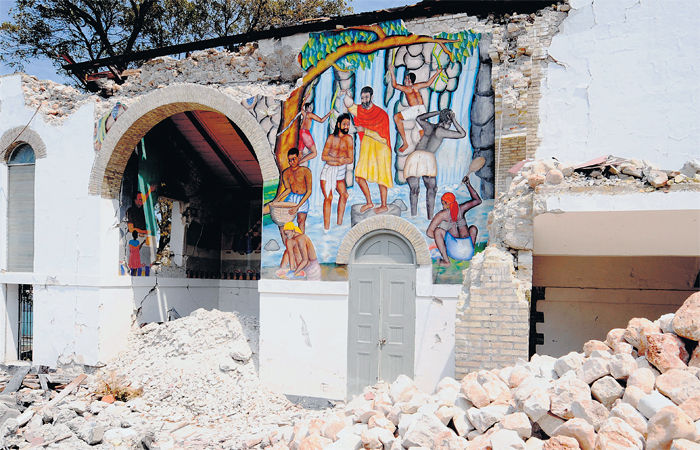
Brilliant colours shine through the ruins of the Cathedrale de la Sainte-Trinite, fragments of wonderful murals that were the climax of Haiti's artistic explosion 60 years ago.
For gallery owner Toni Monnin, the loss of irreplaceable frescoes by the first generation of Haitian master painters is the most powerful symbol of the cultural devastation wrought by the January 12 earthquake.
"There was this explosion of art in Haiti after the Second World War like nowhere else in the world," explained Monnin, a native Texan. "It is a country of painters and artists and it is a phenomenon that exists only here in Haiti."
In the capital Port-au-Prince, a teeming mass of humanity fights to recover from unimaginable horror, but the backdrop is a wall of paintings, vibrant colours splashing canvas and somehow masking the smell of death and loss.
Haiti could lay claim to having a greater concentration of artists than any other country, but beyond them, it is the buildings, the history, the entire cultural heritage of the Caribbean nation that is at risk.
"What we have been trying to do with the minister of culture is raise awareness of the need to protect the heritage because once it is gone, it is gone," Teeluck Bhuwanee, head of the Unesco mission in Haiti, said.
Recorded history dates back to 1492, when Christopher Columbus discovered the island – which Haiti shares with the Dominican Republic – and named it La Isla Espanola, which became Hispaniola.
Artifacts from pre-Columbian times, the era of the Taino Indians, survived the quake largely unscathed at the National Museum of Art, fortuitously located underground.
But many important sites, born out of Haiti's compelling history of slavery and revolution, were not so fortunate, and Bhuwanee fears culture has been forgotten in the government's grand reconstruction plan.
"In Port-au-Prince, there are about 30 sites that have been identified as really in danger of total destruction or total extinction. Two of them have already been razed," he said.
The capital is a graveyard of fallen cathedrals, libraries and cultural sites. Invaluable private collections were also decimated by the quake.
Despite the extent of the loss, the word culture is absent from the draft Post Disaster Needs Assessment (PDNA) drawn up by the government in conjunction with the international community.