'Secret' Giotto comes to light in Italian chapel
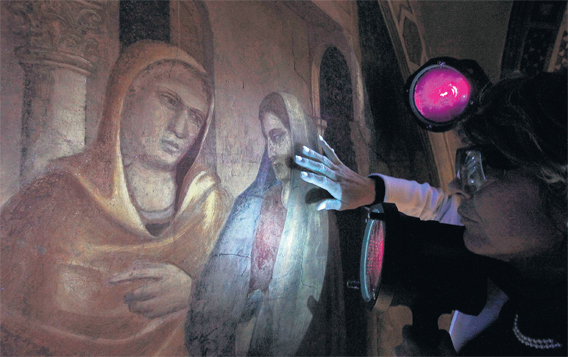
Restorers using ultra-violet rays have rediscovered rich original details of Giotto's paintings in the Peruzzi Chapel in Florence's Santa Croce church that have been hidden for centuries.
"We have uncovered a secret Giotto," said Isabella Lapi Ballerini, head of Florence's Opificio delle Pietre Dure, one of the world's most prestigious art restoration laboratories.
Last year, more than a dozen restorers and researchers began an ambitious project of "non-invasive diagnostics" to ascertain the condition of the 12-metre-high chapel, which the medieval Italian artist painted in about 1320.
The aim of the study, partly funded by a grant from the Getty Foundation in Los Angeles, was to gather information on the 170 square metre chapel to use as a road map and "hospital chart" for a future restoration.
During the project, which lasted four months, restorers working on three stories of steel scaffolding noted that while viewing the paintings under ultra-violet light, they were able see amazing details not visible to the naked eye.
"It was something really astonishing," said Cecilia Frosinini, Co-ordinator of the project that studied the scenes in the lives of John the Baptist and John the Evangelist.
"We knew we could get some very interesting results from our scientific diagnostics but when we looked under ultra-violet light, all of a sudden all these very faint paintings that were ruined by old restorations took on a new life," she said, pointing to one scene while donning protective eye wear.
Giotto's paintings in the lance-shaped chapel are believed to have had a major influence on Michelangelo, who was born nearly 140 years after Giotto died and who painted the Sistine Chapel in the early 1500s.
Today's restorers are seeing the details Michelangelo saw when he admired the paintings by Giotto, considered one of the artists who sowed the seeds for the Italian Renaissance.
"The scenes are again three dimensional... we were able to see all the chiaroscuro effects," she said. "There were bodies under the garments... they became three dimensional, you could see the folds of the garments, the expressions of the faces."
Commissioned by the noble Peruzzi family, the chapel was whitewashed in the early 1700s to make way for a new design. A series of restorations that added to, took away from and sometimes damaged the works culminated in a 1958 restoration restored the paintings to a state as close to Giotto's efforts as possible – this is what visitors to the church see today with their naked eyes.
But even after the 1958 restoration removed "non-Giotto" parts added by 19th century "restorers", the paintings were left faint and anaemic, like a patient who had never fully healed.
And while the details come to life under ultra-violet light, subjecting them to such constant bombardment would be not only impractical but harmful.
The only way to share the discovery with the general public would be with a massive – and expensive – project to allow visitors to enjoy a virtual chapel on computer screens. (Reuters)
Keep up with the latest business news from the region with the Emirates Business 24|7 daily newsletter. To subscribe to the newsletter, please click here.