Secret dossier adds to evidence of chemical weapons in Sudan

The documents bolster allegations that the Sudanese military developed and used toxic bombs to gain an edge in the country’s devastating civil war.

By Courtesy: The New York Times Published: 2026-09-05T17:34:00+04:00 7 min read
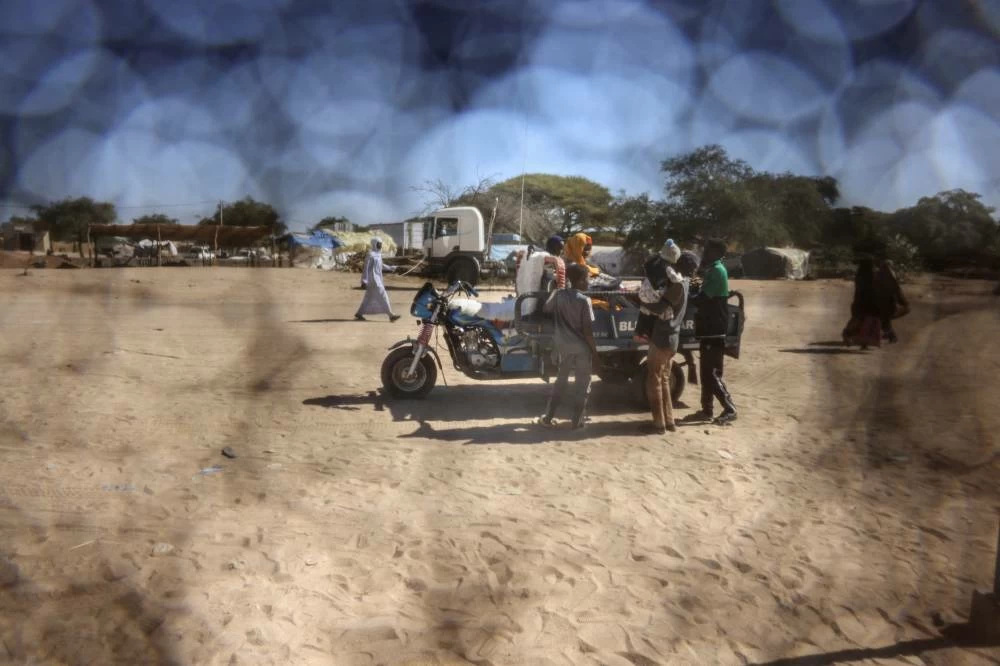
File photo: A Sudanese refugee father from Al Fashir rides on a motorised cart with his family travelling between Chad and Sudan amid the ongoing conflict. (Reuters)

Secretive bomb tests in the Sudanese desert. Suffocated scorpions, found dead on the floor of a weapons factory. Chlorine canisters taken from a water treatment plant in the war-torn capital.

Sudan’s military has long denied American accusations that it used chemical weapons as part of the country’s devastating civil war. That accusation brought punishing U.S. sanctions on Sudan and its army chief, Gen. Abdel Fattah al-Burhan. Yet the United States has never publicly substantiated the claim with proof.

Now, a dossier of evidence shared with The New York Times by a Middle Eastern intelligence agency bolsters those allegations, describing how and why Sudan’s military developed and produced chemical weapons over six months in 2024.

Photographs, videos, documents and intercepted communications portray a secretive Sudanese military unit said to have produced chlorine-based munitions for use against the Rapid Support Forces (R.S.F.), the paramilitary group the army is fighting for control of the country.

The dossier contains bomb blueprints, details of an apparent effort to cover up the project after its discovery by the United States, and a suggestion that some of the chlorine used to make the bombs was sourced at a civilian water treatment center that received the chemical from international aid groups.

The U.S. government appears to have taken the dossier seriously. Some of its visuals were shared with American intelligence and were used by American officials in January 2025 to assess whether Sudan had chemical weapons, according to two foreign officials and a former U.S. official who spoke on condition of anonymity to discuss sensitive intelligence.

A Sudanese military spokesman rejected the dossier’s findings as “baseless and without material foundation.” Noting that Sudan had signed the Chemical Weapons Convention, he threatened legal action against The Times in a U.S. court if the dossier’s contents were published.

Much of the dossier, consisting of nearly 150 documents, images, videos and voice notes, as well as several thousand text messages, appears to come from the cellphones of senior Sudanese officers. It was provided on the condition that its source not be identified.

Voice and text messages involving General al-Burhan suggest Sudan’s military chief had direct knowledge of the alleged chemical weapons effort, a key factor in the U.S. decision to sanction him in January 2025, The Times reported.

Proving chemical weapons use is notoriously complicated. Experts who reviewed images from the dossier for The Times said they looked like a plausible chemical weapons effort, but cautioned they could be confirmed only through an investigation by impartial experts on the ground in Sudan.

While chemical attacks during Syria’s civil war set off global outrage and led to American military strikes in 2017 and 2018, the Sudanese episode has received relatively little outside scrutiny.

Elisabeth Waechter, a spokeswoman for the Organisation for the Prohibition of Chemical Weapons (OPCW), said several countries had requested that the organization “obtain clarifications from Sudan regarding allegations of chemical weapon use.” The process is “ongoing,” she said.

The pressure is coming mostly from the United States, which in June announced a second round of sanctions over chemical weapons as part of a broader effort to force Sudan’s military to agree to a ceasefire.

Sudan’s military has responded to the U.S. measures with defiance, saying it does not trust the United States to be an impartial mediator in the conflict.

A State Department spokesperson said in a statement that sanctions would remain until Sudan destroyed “all chemical weapons and production facilities under international verification.”

Since Sudan’s war began in 2023, it has brought famine and disease and forced more than 12 million people from their homes. While both sides are accused of war crimes, the worst atrocities have been blamed on the military’s enemy, the R.S.F., which the United States and the United Nations say has committed genocide.

The paramilitary group’s reputation touched a new low last year in El Fasher, a city in Darfur, where its fighters were credibly accused of starving, slaughtering and gang-raping fleeing civilians.

The Sudanese military may have turned to chemical weapons to solve a problem early in the war. By mid-2024, the military had lost most of Khartoum, and its forces struggled to expel R.S.F. fighters embedded deep in the vast capital.

In July, according to the dossier, Brig. Gen. Tariq Hussain, the head of the chlorine bomb project, proposed a solution: chlorine.

In a message to colleagues that was later intercepted, General Hussain explained how the deadly gas could be weaponised to gain an edge in the battle for Khartoum. He circulated sketches of prototypes of a new munition that, he said, combined an explosive warhead with about 33 pounds of chlorine gas.

The new munition had the advantage of killing enemy forces either by shredding them with shrapnel or by gassing them with chlorine, he messaged. The explosion would also ensure that no chemical trace of the attack remained.

From July 2024, General Hussain oversaw a factory that assembled prototypes of this munition, according to images and messages in the dossier.

On July 22, an Antonov cargo plane took off from Merowe Airport, about 200 miles north of Khartoum, to test the chlorine-based munition, he reported.

“The test went 100 percent,” General Hussain later wrote, attaching a video of an explosion in the desert. “It fell on the target and released the gas.”

“Strict secrecy,” replied Brig. Gen. Amir Idris, who is identified in the records as a supervisor of military drone operations.

The project also encountered challenges, messages show. Chlorine gas often leaked from the bombs, and one morning workers found dead insects and scorpions scattered across a hangar floor, apparently after suffocating in the night, General Hussain wrote.

The chlorine came partly from global markets. Unlike more notorious chemical agents such as sarin or VX, chlorine is not a controlled substance.

In late August 2024, General Hussain reported the import of 20 chlorine cylinders from Egypt, enough to make 1,100 bombs, he said.

General Hussain also said he obtained chlorine gas from Al Manara water treatment plant in Omdurman, one of the few such facilities still operating during the war.

“Al Manara has some of those cylinders, and we took them from there,” he said in a voice message to General Idris on Aug. 26.

A 2016 public information video about Al Manara shows large yellow chlorine drums similar to those seen inside the munitions factory.

During the war, however, much of its supply was donated by international aid groups, which use chlorine to combat recurrent cholera outbreaks.

In emails, the Red Cross said it donated 30 cylinders of chlorine gas to the plant in 2023, while CARE said it provided 35 cylinders between 2024 and 2025. UNICEF said it supplied chlorine gas to six water treatment plants in Khartoum, including Al Manara, between 2023 and 2025.

A photo provided by a Middle Eastern intelligence agency showed vessels for purported chlorine-based weapons.

The Khartoum State Water Corporation, which runs the plant, did not respond to questions.

By October 2024, General Hussain reported that he had manufactured nearly 300 chemical munitions, most of them stored at the airport in Merowe.

“They drank the gas,” he texted a colleague in September 2024, describing enemy combatants inhaling chlorine gas after an attack.

The documents locate the attack at the Al Jaili oil refinery, north of Khartoum, which was then controlled by the R.S.F.

His claim to have used chemical munitions at the refinery was corroborated by his enemies and by news reports.

On Sept. 13, the R.S.F. released a statement accusing the Sudanese military of firing “toxic” missiles at the refinery. Photographs circulating on social media showed men in civilian clothes wearing oxygen masks at the site.

An investigation by France 24 documented chemical strikes at the oil facility. However, the French investigation concluded that the chlorine bombs were large gas cylinders, not the smaller munitions described by General Hussain. The reason for the discrepancy was unclear.

There were no confirmed deaths.

Other reported strikes are harder to verify. On Oct. 17, General Hussain reported a second strike on a munitions factory that he said caused heavy casualties and led people to flee to nearby villages.

That attack did not feature in R.S.F. statements or social media reports at the time.

The alleged chemical weapons programme appears to have ended after the United States imposed sanctions in May 2025. Days later, General al-Burhan instructed General Hussain to “remove all traces” of its activities, according to intercepted communications.

“The operation was done a month ago,” came the reply.

During the latest round of sanctions in June, the United States sanctioned General Hussain for importing explosives to make bombs, although the notice did not mention chemical weapons.

By then, General al-Burhan had established a committee to investigate the American allegations. According to a letter in the dossier, the committee’s advisers included General Hussain, the architect of the programme.

When the committee submitted its interim report in July, it said it found no trace of chemical weapons. A final report is pending.

---