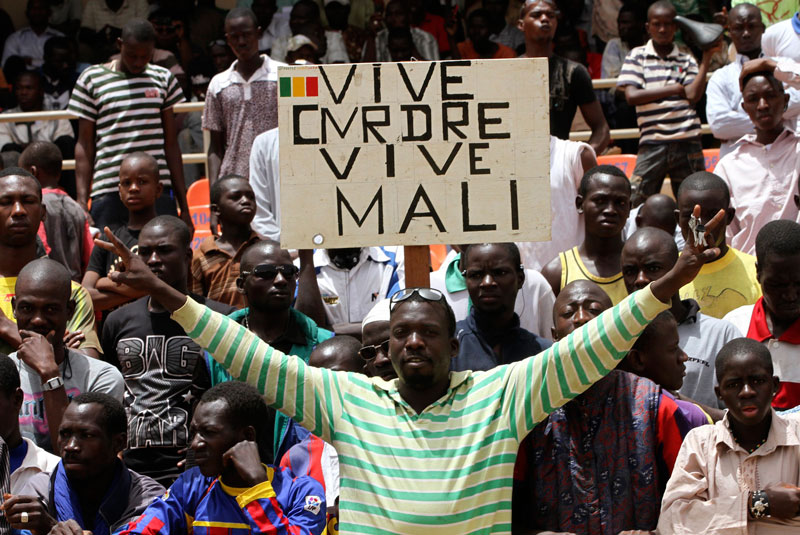
The junior officer who overthrew Mali's democratically elected leader earlier this month and dissolved the nation's constitution made a public U-turn on Sunday, declaring amid enormous international pressure that he was reinstating the 1992 constitution and planning to hold elections. Capt. Amadou Haya Sanogo added that he would organise a national convention to organise free and fair elections. What he did not make clear is when the elections would be held, and if he would remain president during the transitional period. As he approached the podium to address reporters, his bodyguards shouted out, ``The president is coming!'' Sanogo's announcement came as Tuareg rebels penetrated the ancient northern city of Timbuktu, a move that deepens the crisis in the West African nation. The Tuareg rebels are taking advantage of the chaos surrounding last week's coup in the faraway capital to take the town of Kidal, located 1,300 km from Bamako on Friday. They seized the biggest northern city of Gao, located around 1,200 km away on Saturday -- cities that never fell in previous rebellions. A resident in Timbuktu said that the rebels entered the town after a heavy firefight, and were going house to house asking people to remain calm. Mali, once a model democracy, was plunged into crisis on March 21 when a mutiny erupted at the Kati military camp located around 10 km from the presidential palace. The 30-something Sanogo was one of the few officers who didn't flee the camp when the rank-and-file soldiers began rioting, and he quickly became their leader as they broke into the camp's armoury and grabbed automatic weapons and headed for the seat of government. His coup reversed 21 years of democracy, and President Amadou Toumani Toure sent into hiding. Toure was due to step down after a presidential election scheduled for this month. Mali's neighbours had given the country a 72-hour deadline to restore constitutional order, or else face crippling sanctions, which expires on Monday. Sanogo's declaration appears intended to stave off the sanctions. Legal experts say that his declaration is contradictory. If the 1992 constitution is reinstated, said law professor Malick Sarr at the University of Bamako, then logically the ousted president should become head of state again. Sarr said the putschists may be leaning on one of the articles in the 1992 law, which says that in the event that the president is unable to carry out his functions, a 25- to 45-day transitional period will go into effect before new elections are held. However, the article clearly stipulates that the transition will be led by the head of the national assembly. When reporters asked the coup leader if he still considered himself president, he dodged the question, and turned to leave.