PISA 2025: 90% of UAE students study in phone-free schools, nearly double the OECD average

New international data shows digital distraction costs UAE students 24 points in science scores, as 114 education systems worldwide now implement national phone bans

By Mohammed Ibrahim Published: 2026-09-10T05:28:00+04:00 8 min read
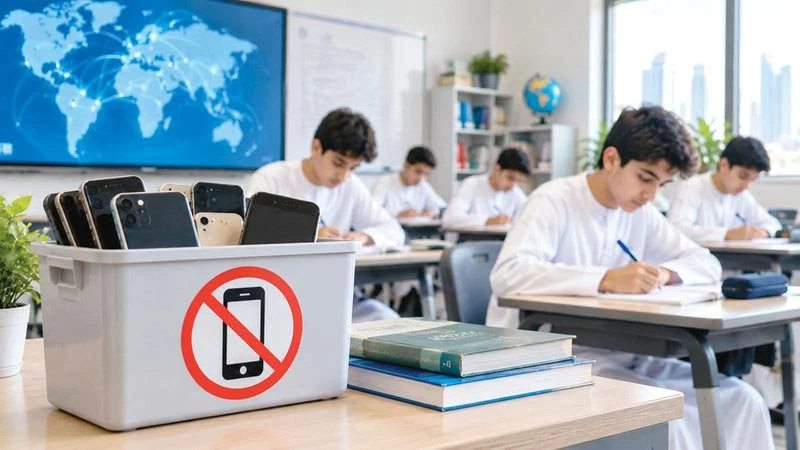
PISA data showed that UAE students use digital devices for learning purposes within the school at a rate of 1.9 hours per day, compared to 1.7 hours in the organisation’s countries. Picture credit: AI-generated expressive image

Dubai: The latest results of the Programme for International Student Assessment (PISA) 2025 revealed that the UAE is making progress in controlling phones inside schools, as 90.1% of the country’s students study in schools that do not allow their use, compared to 49.5% in Organisation for Economic Co-operation and Development (OECD) countries. 

Experts and academics confirmed that banning phones in schools enhances the learning environment and reduces digital distractions.

PISA data showed that UAE students use digital devices for learning purposes within the school at a rate of 1.9 hours per day, compared to 1.7 hours in the organisation’s countries.

On a broader scale, the movement to keep phones out of schools is gaining global momentum, having moved from a limited disciplinary measure to a broad educational policy, with the number of education systems implementing a national ban on phones rising to 114, covering 58% of the world's countries.

The data places the phone at the heart of the attention battle within the classroom, as 23% of UAE students reported that their classmates were frequently distracted by digital devices during most or all of their science classes, compared to 28% in OECD countries. Students studying amidst this distraction scored 24 points lower in science compared to their peers who were not exposed to it, after accounting for socioeconomic backgrounds, compared to an 11-point difference at the OECD level.

The indicators gain particular importance with the 2026-2027 academic year, in light of the tightening of phone controls in schools in the UAE, in parallel with the expansion of technology and artificial intelligence, thus establishing a clear equation: restricting the distracting personal device, and expanding targeted educational technology.

Restricting use of phones

In detail, data from UNESCO’s Global Education Monitoring Report reveals a remarkable acceleration in the ban, as the percentage of education systems implementing a national ban on phones rose from 24% in 2023 to 40% at the beginning of 2025, and then to 58% last March, equivalent to 114 education systems.

In the United States, 39 states have implemented bans or require school districts to restrict phone use, while models vary globally between banning the device for the entire school day or only during class, with exceptions for educational purposes, health conditions, and people with disabilities.

UNESCO links this shift to growing concerns about distraction, cyberbullying, and the impact of digital use on student well-being, but it emphasises that banning alone is not enough, and that what is needed in parallel is to build digital culture and the student's ability to manage the screen.

Ban the phone, not the technology

According to PISA, 96.3% of UAE students reported that their schools have subject-related guidelines for the use of digital devices, while 81.7% said they are learning how to evaluate information produced by artificial intelligence. The figures reveal the essence of the UAE model: the personal phone outside of class, and educational technology at its heart.

Local regulatory frameworks reinforce this trend, as schools' commitment to procedures for not bringing mobile phones onto school grounds is included in the inspection of private schools in the Northern Emirates, while educational authorities place the regulation of devices within the system of discipline, safety and school conduct.

Families are essential partners

Parent Adel Shehata believes that the essence of the ban lies in giving the student daily hours during which he/she can disconnect from notifications, conversations and games, thus restoring more space for focus and direct interaction within the school, especially since the effect of distraction is not limited to the phone user, but extends to those around him.

Parent Mohammed Taha places emergencies and communication with children at the forefront of family concerns, which necessitates providing a fast and reliable school channel that allows the family to reach the student when necessary, without turning the exception into an outlet that returns the phone to daily use.

Parent Mayada Yassin believes that the school ban loses some of its effect if the student returns to unrestricted screen use after school, making the family an essential partner in controlling digital time. This view intersects with UNESCO's emphasis that the ban should be accompanied by building awareness and self-control.

Restoring focus in classrooms

From inside the classroom, teacher Asmaa Ammar places restoring the student's focus and the lesson time at the forefront of the gains of controlling the phone, especially since the digital interruption does not end as soon as the screen is turned off, but rather breaks the chain of attention and affects the continuation of the educational task.

The UAE data confirms the scale of the challenge. In PISA 2022, 24% of students reported that digital devices distracted them in most or all of their math classes, and 22% said that their classmates’ devices distracted them. The 2025 results showed that 23% continued to be distracted by their classmates’ devices during science classes.

Teacher Samar Mohammed distinguishes between the phone and educational technology. A device used for a specific task under the supervision of the teacher is different from a personal phone that combines the lesson, messages, games, and communication platforms on one screen, making the issue one of regulating use rather than excluding technology.

Testing during implementation

Michael Bartlett, Director General of Dubai Modern Education School, places daily implementation at the heart of the policy’s success, as clear mechanisms make all the difference, starting from the student’s entry into the school, through dealing with the violation and its repetition and informing the family, and up to ensuring communication in urgent cases.

International experience reveals that the existence of a ban on paper does not mean the disappearance of the phone from the classroom, which makes consistency in application between the administration and teachers and family cooperation a condition for turning the decision into a sustainable school behaviour.

Enhancing the learning process

Educational expert Dr. Ahmed Al Ali said the success of phones is linked to the quality of learning and reduces digital distractions but it alone does not guarantee higher grades. Picture credit: Supplied

Experts and academics have confirmed that banning phones enhances the learning environment and reduces digital distractions. Educational expert Dr. Ahmed Al Ali linked the ban to the quality of learning, given the evidence linking digital distractions to weaker performance, without asserting that the ban alone raises grades.

The results from the UAE stand out here, as students who reported frequent digital distraction among their peers scored 24 points lower in science, compared to an 11-point gap in OECD countries. This poses a question for schools that goes beyond device control to measuring the actual impact of policy on participation, focus, and achievement.

Educationalist Dr. Fares Al-Jabour believes that the success of the policy is not measured by the number of confiscated phones, but rather by the time the school recovers from learning, the student's focus, and the teacher's ability to manage the lesson, provided that control gradually develops from external prohibition to the student's own ability to control its use.

Artificial intelligence’s role

Dr. Issa Al-Bastaki, believes that the UAE’s progress in artificial intelligence (AI) and digital education does not conflict with banning personal phones. Picture credit: Supplied

The President of the University of Dubai, Dr. Issa Al-Bastaki, believes that the UAE’s progress in artificial intelligence (AI) and digital education does not conflict with banning personal phones, as digital transformation is not measured by the number of hours spent in front of a screen, but rather by the value of its use.

The results support this trend, as 64.3% of UAE students use artificial intelligence at least weekly to help with learning, while 81.7% of them learn how to evaluate the information it produces, reflecting the school’s shift from “using technology” to teaching the student how, when, and why to use it.

Success indicators

Educational expert Dr. Jamal Mujahid places measuring results at the forefront of the next stage, stressing the importance of not reducing success to the disappearance of the phone from the desks, but rather measuring it through focus, classroom participation, achievement, violations, cyberbullying, social interaction, and actual teaching time.

International studies support this caution. A British study of 1,227 students in 30 schools found that restrictions reduced phone and social media use during the school day, but did not register significant differences in mental health, sleep, physical activity, or achievement, and did not reduce overall phone use outside of school. The conclusion is that the school can protect school hours from the phone, but it cannot alone manage the rest of the student's day.

Building attention and self-control 

Dr. Iman Mohammed Jawhar, a consultant in mental and educational health, places the issue in the ability of the child and adolescent to control attention, postpone responding to notifications and the frequent urge to check the screen, stressing that confiscation should not become an end in itself, but rather a tool within an educational process that builds self-control. 

This becomes more important with the results of PISA 2025, which included about 760,000 students in 91 countries and economies, and brought digital distraction back to the forefront of the global debate on the quality of learning, at a time when the Organization for Economic Cooperation and Development confirms that technology and artificial intelligence can support education when their use is linked to a clear goal, and not when they become a substitute for attention and effort.

The comparison reveals that the UAE has made significant progress in regulating personal phones, with 90.1% of its students in schools that do not allow their use, compared to 49.5% in OECD countries.

Phones banned and confiscated until the end of the year

The Ministry of Education has banned bringing mobile phones onto school premises and has obligated schools to adhere to specific regulations for inspection, confiscation, and dealing with violations, according to a circular it issued to school and kindergarten directors, based on Ministerial Resolution No. 851 of 2018, regarding the regulations for managing student behaviour in public education institutions, specifically Article (7) concerning second-degree violations (2.7), related to bringing a mobile phone or misusing means of communication.

The ban aims to protect students from the harms associated with carrying and using phones inside the school, promote positive behaviour, and establish a safe educational environment. The Ministry has obligated schools to implement periodic inspection campaigns to detect smartphones, in accordance with approved regulations and in a manner that preserves the privacy of students.

Firm procedures were established to deal with violations, as any phone found in the student’s possession inside the school will be confiscated, the parent will be notified, and the device will be held for a month the first time, and until the end of the school year if the violation is repeated.

The Ministry stressed the application of penalties stipulated in the code of conduct against students who use phones for illegal, immoral, or abusive purposes, with the parent being notified immediately upon detection of the violation, summoned and informed of its details, and signing the approved official forms, which are “Form 24” when the phone is confiscated, and “Form 25” when it is returned.