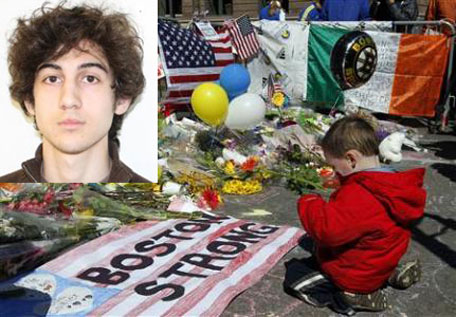
The surviving suspect in the deadly Boston Marathon bombing remained unable to speak with a gunshot wound to the throat, while the city's police commissioner said the two suspects had such a large cache of weapons that they were probably planning other attacks. Federal authorities want to question the wife of the suspect who died after a gun battle with police, her lawyer said. Katherine Russell Tsarnaev learned her husband was a suspect by seeing it on TV, Amato DeLuca told The Associated Press late Sunday. Authorities found many unexploded homemade bombs at the scene of the gun battle early Friday, along with more than 250 rounds of ammunition. The stockpile was "as dangerous as it gets in urban policing," Boston Police Commissioner Ed Davis said. "We have reason to believe, based upon the evidence that was found at that scene — the explosions, the explosive ordnance that was unexploded and the firepower that they had — that they were going to attack other individuals," he told CBS. Davis told Fox News that authorities cannot be positive there are not more explosives somewhere that have not been found. But he insisted the people of Boston are safe. Investigators have not offered a motive for the marathon attack. Churches mourned the dead and consoled survivors Sunday. The suspects in Monday's twin bombings at the marathon finish line that killed three and wounded more than 180 are two ethnic Chechen brothers from southern Russia who had been in the US for about a decade — 19-year-old Dzhokhar Tsarnaev and his 26-year-old brother, Tamerlan. Their motive remained unclear. The older brother was killed in Friday's gun battle. The younger brother was still in serious condition Sunday after his capture Friday from a tarp-covered boat in a suburban backyard. Authorities would not comment on whether he had been questioned. Sen. Dan Coats, a member of the Senate Intelligence Committee, said Dzhokhar Tsarnaev's throat wound raised questions about when he will be able to talk again, if ever. The wound "doesn't mean he can't communicate, but right now I think he's in a condition where we can't get any information from him at all," Coats told ABC. It was not clear whether Tsarnaev was shot by police or wounded himself. In the final standoff with police, shots were fired from the boat, but investigators have not determined where the gunfire was aimed, Davis said. Tsarnaev could be charged any day. The most serious charge available to federal prosecutors would be the use of a weapon of mass destruction to kill people, which carries a possible death sentence. Massachusetts does not have the death penalty. US officials said an elite interrogation team would question Tsarnaev, a college student, without reading him his Miranda rights, which guarantees the right to remain silent and the right to an attorney. Such an exception is allowed on a limited basis when the public may be in immediate danger, such as instances in which bombs are planted and ready to go off. The federal public defender's office in Massachusetts said it has agreed to represent Tsarnaev once he is charged. In an interview with The Associated Press, the parents of Tamerlan Tsarnaev insisted Sunday that he came to the southern Russian regions of Dagestan and Chechnya from January to July last year to visit relatives and had nothing to do with the militants operating in the volatile region. His father said his son slept much of the time. When the two suspects were identified, the FBI said it reviewed its records and found that in early 2011, a foreign government — which law enforcement officials confirmed was Russia — had asked for information about Tamerlan Tsarnaev. The FBI said it was told that Tsarnaev was a "follower of radical Islam" and was preparing to travel to this foreign country to join unspecified underground groups. The FBI said that it responded by interviewing Tsarnaev and family members but found no terrorism activity. No evidence has emerged since to link Tsarnaev to militant groups in Russia's Caucasus. The Caucasus Emirate, which Russia and the US consider a terrorist organization, on Sunday denied involvement in the Boston attack. Chechnya has been the scene of two wars between Russian forces and separatists since 1994. That spawned an insurgency that has spread throughout Russia's Caucasus, with the worst of the violence now in Dagestan. Despite the violence, Anzor Tsarnaev said Sunday that his son did not want to leave and had thoughts on how he could go into business. But the father said he encouraged him to go back to the United States and try to get citizenship. In interviews with officials and those who knew the Tsarnaevs, a picture has emerged of the older brother as someone embittered toward the US, increasingly vehement in his Muslim faith and influential over his younger brother. The federal Bureau of Alcohol, Tobacco, Firearms and Explosives was tracing the suspects' weapons to try to determine how they were obtained. Neithe