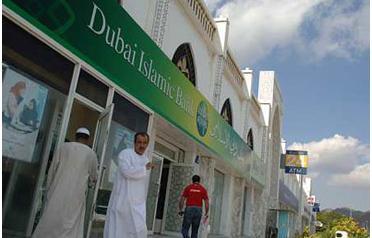
Islamic banks in the UAE are outperforming their conventional rivals in terms of profitability, liquidity and earnings per share, according to a new report. And the study said the Shariah-compliant banks have not been seriously affected by the fallout from the global financial crisis as they operate to different standards in terms of loans and investment tools. The study was compiled by Dr Mohammed Naeem Shaker, Professor at the Finance Department of the College of Business Administration at Ajman University of Science and Technology, and Dr Abdalla Salih, Assistant Professor at the college’s Accounting Department. It was discussed at the fourth Forum for Accounting and Auditing Bureaus and Companies in GCC countries which was held in the capital. The report said the number of Islamic banks in the UAE and the world rose during the worst period of the crisis when demand for Shariah-compliant banking services and products increased. Three of them opened in the UAE alone during 2008 – Noor, Al Hilal and Ajman. And the number in European countries is expected to increase over the next few years. Dr Salih told Emirates Business that the study compared the financial situation of three Islamic banks, Dubai, Abu Dhabi and Sharjah, with three traditional banks, NBD, NBAD and ADCB over the years 2006 to 2009 and concluded that the Islamic banks performed better in terms of profitability, liquidity and earnings per share. “The study has proved that the performance of the three Islamic banks was good and they were not basically affected by the fallout from the crisis,” he said. “They maintained their profitability level and their liquidity level went up. Also, there was an increase in the ratio of shareholders equity to total liabilities and equity. “And the ratio of liabilities to the value of assets remained steady or varied only slightly. And there was a clear rise in earnings per share.” In contrast, the study said the profitability of the conventional banks was greatly affected over the same period, especially as a result of the financial crisis in 2008 and 2009. Also the level of liquidity went down. However, the conventional banks maintained their level of earnings per share or experienced only a slight difference. The ratio of liabilities to the value of assets was steady or changed only slightly and the ratio of shareholders’ equity to total liabilities and equity rose. Dr Salih said the profits of the four Islamic banks listed on the Abu Dhabi and Dubai financial markets – Dubai, Abu Dhabi, Sharjah and Emirates – increased in the first quarter of 2009 compared with the last quarter of 2008. Sharjah Islamic Bank and Emirates Islamic Bank made profits after recording losses in the fourth quarter of 2008. And Abu Dhabi Islamic Bank’s profits grew by 134 per cent in comparison with the last quarter of 2008 after it drew on the liquidity offered by the federal government. At the height of the global crisis Dubai Islamic Bank occupied third place in Meed’s list of the largest 20 Islamic banks in the Gulf in terms of assets, and June 30, 2009, these topped $23.9 billion (Dh87.78bn). Abu Dhabi Islamic Bank came fourth with $15bn, Emirates Islamic Bank was eighth ($6.8bn) and Noor Islamic Bank was 10th ($6bn). During the crisis the Islamic banks’ profits rose, especially those of Dubai Islamic Bank whose profits went up by 31 per cent in the first quarter of 2009. Mohamed Albeltagi, Head of the Shariah Department at the former National Bank for Development in Egypt, now known as the Abu Dhabi Islamic Bank – Egypt Branch, said Islamic banks in the UAE were among the best in the world in terms of growth, performance and compliance with Shariah regulations. The UAE was the first country to establish an Islamic bank – Dubai Islamic Bank. “The number of Islamic banks is increasing greatly around the world and the rate of increase during the global financial crisis reached some 28 per cent. The assets of the the 700 Islamic banks went up to $822bn this year from $650bn in 2008. And the assets are expected to rise to $1.3 trillion in 2010. The figure is based on an annual growth rate of 15 per cent to 20 per cent. “Islamic banks have survived the global financial crisis since no Islamic bank has announced bankruptcy, unlike banks that pay interest in America and elsewhere in the West where the number of bankrupt banks has reached 100. Islamic banks have financial tools that are totally different from those used by traditional banks and they have not been involved in charging interest on loans. Also Islam forbids the sale of debts and the issue of bonds with interest as well as margin selling. They do not give credit without carrying out detailed studies.” Albeltagi said Islamic banks had set financial tools and Shariah alternatives including sukuks. Islamic finance prohibits bonds with interest and instead allows approved investment sukuks. Dubai and Malaysia are the world leaders in sukuks, which are issued against fixed a