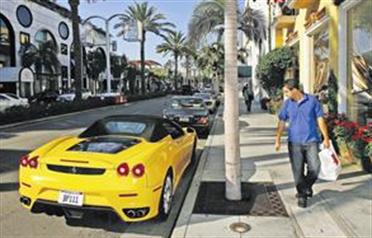
You might be forgiven for thinking this was a rotten moment in history for the mega-rich. Crooked hedge fund managers such as Bernard Madoff seem to be waltzing off with your fortune. Taxes are being raised around the world, and are likely to rise further. For those in the Middle East, luck might just be running out as governments debate the pros and cons of tax. And elsewhere, every politician running for election is taking potshots at the excesses of bankers and oligarchs. Even the offshore financial centres, usually the one place you could count on to welcome you with open arms and a waiting limo, are contemplating handing over the details of all your accounts to the tax authorities back home. It's enough to leave you crying into your last glass of bubbly. But don't be downhearted. There has never been a better time to be mega-wealthy. The plutocracy is entering a gilded era. The reasons are simple: All the things you need to maintain your lifestyle are getting cheaper. And there are a lot fewer of you around. The main point about being rich is not how much you have, but whether you have more than everyone else. Anyone who tracks the price of luxury items knows that while life is harder for ordinary people, it is getting cheaper for the seriously wealthy. London-based wealth-management firm Stonehage calculates the cost of living for what it calls "ultra high net worth families". Its index includes everyday essentials such as Beluga caviar, dinner at the Ivy, a day's grouse shooting, a grand tier box at the Royal Opera House, and breast-enhancement surgery (in case the trophy wife isn't quite as impressive as she should be after all that Beluga). None of them are cheap. They are, however, a bit cheaper than they used to be. Stonehage says the price index dropped about four per cent in the 12 months through April 2009, as luxury-property rents and discount-travel deals fell. By contrast, the inflation rate for the rest of the United Kingdom population, measured by the consumer-price index, was more than two per cent. Meanwhile, the World Wealth Report produced by Capgemini SA and Merrill Lynch Global Wealth Management found the number of millionaires in the UAE shrank by 12.7 per cent to 67,000 last year, as the ranks of the wealthy across the world thinned out amid the global economic downturn. In the Middle East, the total number of High Net Worth Individuals, or HNWIs, dropped to 373,600 and their wealth declined 16.2 per cent to $1.4 trillion. In a statement, Amir H Sadr, head of Middle East Global Wealth Management at Merrill Lynch, said: "The fall in the UAE's HNWIs was steeper than the Middle East average of 5.9 per cent as the result of a huge contraction in market capitalisation, as well as the overall drop in real estate prices and rentals. Besides, UAE HNWIs had heavy investment in Asia and Europe where economic conditions were more challenging." Across the Atlantic, US-dollar millionaires in the world also dropped 15 per cent last year to 8.6 million people, wiping out the increase in their ranks during the previous two years. The overall value of assets held by millionaires dropped 20 per cent to $32.8 trillion (Dh120trn) in 2008. Clearly that is unfortunate for those who have dropped out of the club, and have to reacquaint themselves with coach class on airlines, and finding out where the local Hyundai dealer is. Still, there is no cloud without a slither of silver in it somewhere. And the thinning of the ranks of the world's wealthy is good news for those who remain. In reality, whether you are rich or not doesn't depend on how much money you have, or the possessions you own. It depends on what everyone else has. It's all relative. Obviously, it is better if you are ahead of the pack by making lots of money. But if everyone else loses cash, and you stay where you are, you can achieve the same result. The last two decades, marked by successive bull markets, were a period of rising mass affluence. Everyone seemed to be getting richer all the time, which made it harder for the loaded to stay ahead of the game. A limo? Every weekend they were cruising around big cities. A Rolex? They were selling them in every mall. A private jet? They could be rented by the hour. At the same time, rising asset markets meant new millionaires were being minted by the second. Take London, for example. By 2007, anyone who owned a modest family home in the British capital could hardly help but be a millionaire. Much the same was true in the United States, Ireland or Spain. There wasn't much cachet to being a millionaire anymore. Now that has been thrown into reverse. Mass affluence is on the retreat. It won't return any time soon. The property market may not be sinking like a stone anymore, but it will be years before anyone makes money by buying a house. The credit won't be available. Nor are the financial markets going to be spitting out 29-year-olds with million-dollar bonuses the way they did for much of the l