UAE leaps onto world art stage at Venice
One small step for the UAE, one giant leap for our art scene.
Critics who have dismissed art that comes out of the Emirates as being little more than gold-painted camels on canvas might be pleasantly surprised at the way the inaugural UAE pavilion at this year's Venice Biennale approaches the subject.
The biannual event, first organised in 1895, is considered by many to be the most important exhibition of contemporary art in the world. Laid out in national pavilions, it serves up some of the world's most important art and brings some 900,000 visitors to this real-life theme park of a city over a period of six months.
This year, the UAE becomes the first Gulf country to establish a national pavilion at the event, which opens to the public tomorrow and runs through till November 22.
And while the national pavilion model may well be considered rather outmoded by many in the art world, for the UAE's artists, this inaugural representation has piqued the curiosity of the caviar-crunching set: "A friend of mine told me we're being referred to as the 'post-colonial hot potato of the year'," laughs pavilion curator Tirdad Zolghadr.
"It shows the world we're about more than just skyscrapers, that we're human and we have something to say, that we're not apologetic about anything," says Lamya Gargash, the pavilion's featured artist.
Parallel with the pavilion, the Abu Dhabi Authority for Culture and Heritage is hosting a display platform for visual art by national and international artists. Supervised by art historian Catherine David, it features still and animated photographs, architectural models and works of art aimed at changing stereotypes of the region, as well as possible visions for the future of art in the overall process of cultural development in Abu Dhabi.
For the pavilion, Zolghadr attempts a world fair approach, exhibiting the work of a cross-spectrum of UAE artists, including Group of Five founder Hassan Sharif, Ebtisam Abdul Aziz, Huda Saeed Saif and Tarek Al-Ghoussein alongside a display of the country's arts infrastructure, with models of the new museums being built at the Saadiyat Island and Dubai Culture Village.
In documenting the nation's art scene, Berlin-based artist and dramaturge Hannah Hurtzig presents a video installation featuring conversations with five cultural figures or "nation builders" in the Emirates, while a recorded video performance by theatre troupe Jackson Pollock Bar recreates the press conference announcing the UAE Pavilion at the Art Basel Miami Beach.
Beginning with the pavilion's title, 'It's Not You, It's Me,' Zolghadr attempts to both showcase art within accepted parameters while simultaneously questioning the way we look at it. "By and large, art professionals around the world dismiss the notion that a pavilion can truly represent a nation. There still remains much to consider – your citizenship can still largely determine your career, and the way your art is produced, circulated and received," he says of the title. "Coming from a new arrival at the Venice Biennale," Zolghadr continues, "the title 'It's Not You, It's Me' might therefore be interpreted to mean, it's not the art that's the problem, it's the audience, or vice versa, or 'look, it's the UAE's turn now'."
He calls the pavilion an exhibition about exhibitions and uses it to critique the two-yearly format. So by putting a lot of art into one corner in a curatorial experiment, he's making a statement about space: "There's heaps and heaps and heaps of art at the Biennale – but if you're going to heap up art like sundried vegetables, do it for a reason."
In recent years, he adds, soul-searching biennials have begun to invade the space traditionally inhabited by commercial art fairs. "But biennials are normally the place to take risks, where you have the guts to do things you would not normally do – and that's getting lost."
In that context, exhibiting architectural models of under-construction museums cocks a snook at the Emirates's relentless focus on development and our build-it-and-they-will-come approach. "Some people are horrified by the models," says Zolghadr, "others say that's the best thing that's happened."
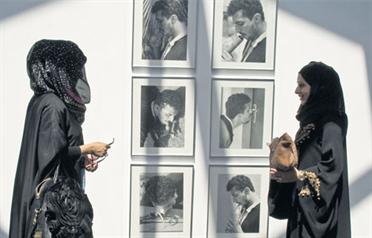
Gargash's work, too, breaks down the shiny stereotype. Familial, her installation of photographs of 31 one-star hotel rooms across the UAE, offers another view of the nation popularly associated with the sail-shaped Burj Al Arab Hotel.
"These are intimate, humane spaces that offer an image contrary to the cliché of skyscrapers and the best of the best associated with Dubai. And that ties into labels," she says, telling of the challenges she faced a young Emirati woman going into cheap hotels. "Strip away a label based on other people's perceptions and you might be surprised at what you find," she adds, neatly skewering those aforementioned critics.
Biennale highlights: how the recession impacts art
The art extravaganza that is the Venice Biennale opens its doors tomorrow, inviting the visitor into a wide, multi-dimensional world of contemporary creations. "We now live in a totally multi-centric art world," Daniel Birnbaum, the Swedish director of the venerable show's 53rd edition, told a press conference.
"In difficult times, in complex times, you have works of art completely different from each other that are hinting at the same situation from a completely different point of view," said the art critic and philosopher. Thus, a crude wooden Greater G8 Advertising Market Stand by Zambian artist Anawana Holoba offers products from poor Third World countries, while South Africa's Moshekwa Langa suggests sweatshop exploitation with his installation of industrial spools of thread, toy cars and empty bottles.
"A work of art is more than an object, more than a commodity," says Birnbaum. "It represents a vision of the world, and if taken seriously must be seen as a way of making a world."
Some have seized on Birnbaum's theme of 'Making Worlds' to focus on destruction, as with Italian artist Michelangelo Pistoletto's roomful of enormous gilt-framed mirrors, half of them lying in shards on the floor at the entrance to the Biennale. In Argentinian Tomas Saraceno's world, the infinitessimal marries the infinite with his Galaxies Forming Along Planets Like Droplets Along the Strands of a Spider's Web, made of huge black spheres of elastic black rubber anchored to the floor and ceiling.
Then there is the real world, where "there is no art that is absent from history," according to Birnbaum, who at 46 is the youngest curator in the Biennale's 114-year history.
However, he said, "Art is something that develops over time in a different way than what you can measure by clocks. There's a different kind of temporality."
A disturbing shadow play by Hong Kong-born Paul Chan, titled Sade for Sade's Sake, evokes the torture by US soldiers at Iraq's Abu Ghraib jail.
Tibetan artist Gonkar Gyatso's Reclining Buddha, which shows a timeline of fluctuating relations between Beijing and Tibet, draws the viewer to faint cartoons of Westerners discussing the stock market or the latest fashion trends.
Indifference to human suffering appears in many other guises, notably in some of the works shown at the Biennale's national pavilions.
In an installation outside the Nordic pavilion, a man floats face down in a swimming pool as visitors walk by, chatting and sipping Proseccos offered during the Biennale preview.
Briton Steve McQueen suggests a desirable sort of indifference as one possible story line among many in his 30-minute film Giardini set in one of the two venues of the Biennale, the gardens at the end of Venice's Castello island.
There is no dearth of political commentary at the pavilions, notably with Chechen artist Andrei Molodkin's The Red and the Black, a multi-media creation featuring two glass replicas of the Louvre's iconic Winged Victory.
Actual blood donated by Russian soldiers who fought in Chechnya pumps through one, while oil pumps through the other. Their images are projected on a wall both singly and superposed. "Blood is the price to pay for oil, Molodkin told AFP. "People kill each other for black gold."
The event, which runs until November 22, boasts a new participation record, with 90 artists in the main programme and 77 countries represented in the pavilions. (Gina Doggett)
Keep up with the latest business news from the region with the daily Emirates Business 24|7 newsletter. To subscribe to the newsletter, please click here.