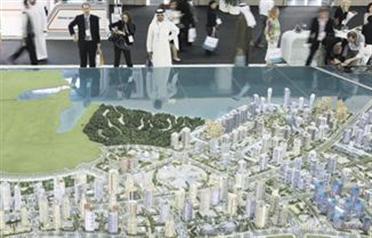
The third edition of Cityscape Abu Dhabi, which winds up today, has revealed positive market trends that will contribute to the recovery and stability of UAE's real estate sector. Before the Sunday opening, the million-dollar question on the minds of thousands of investors who flocked to the Abu Dhabi National Exhibition Centre was whether the exhibition will be a success, is there a future for investment in general and that of real estate sector in particular in Abu Dhabi, and the Gulf, and if rumours of Dubai and the UAE being turned into "ghost towns" were real. But when the exhibition opened, investors saw for themselves the reality of real estate investments in Abu Dhabi and went home reassured. And over the course of the exhibition, six positive trends emerged that showed the strengthen of the UAE's property sector. The first was Abu Dhabi's Government strongly intervening to preserve its real estate sector as well as the rights of those working in the sector. And if new projects disappeared, which is justified given the global financial crisis, the Abu Dhabi Government made up for the shortage by launching projects such as the Capital District development with its vast service facilities, which will totally redraw Abu Dhabi's map and image. The government has also backed some big companies such as Aldar, which will build Al Falah residential city for the government at a cost of Dh9.4bn. Al Qudra Real Estate announced the government has bought a majority stake in its Al Ain Al Faidha project. The Abu Dhabi Municipality said it will spend Dh10bn this year on the emirate's infrastructure, while the government said it will spend billions of dirhams on transport projects, new labour centres and the new port. This proves the government's strategic plan under the current crisis is to support the real estate, construction and infrastructure sector by steering it towards vital and strategic projects, which will yield fruit in the coming years. Two major Abu Dhabi projects, the zero emissions Masdar City and the new Capital City District, took the top places at the Cityscape Awards for Real Estate in the Middle East for their unique contributions towards architectural excellence and sensitivity to the environment. And although some investors saw the absence of new projects as a negative aspect, this is a second positive trend, said industry captains. CEO of Al Odaid Real Estate Mahmoud Al Shaibani, said Abu Dhabi real estate companies are currently heading for the completion of scores of big projects announced over the past three years and which were mostly not executed. Al Shaibani said "the crisis has put us face-to-face with the truth that we should not unveil projects on paper day and night. But these projects have to see light. And of course, the boom period saw wrong practices. Here we are entering the correction and execution era, and this the biggest positive outcome of the financial crisis." "The new trend is to show videos on construction phase of projects, which was absent in the previous session. Therefore, projects will turn into reality, and today there are institutions closely following up developments to protect everybody's rights. The third trend was the absence of speculators. Member of Abu Dhabi Chamber of Commerce and Industry and Chairman of the Real Estate Committee, Otaiba Al Otaiba, said phenomenon of speculators was a dangerous one, which Abu Dhabi got rid of. Foreign speculators exploited the real estate boom in Abu Dhabi – they would buy a square foot for Dh1,200 and resell it for some Dh3,000 or Dh4,000 in days. We have seen how small speculators turned into emperors, but the financial crisis broke their backs. So it was natural to see only the real buyers." The general opinion was that there is demand from investors but they are old fashioned investors who are looking at the long term rather than the flashy speculators of recent years. The fourth positive trend was the drop in prices by up to 30 per cent. Director-General of Truth Economic Consultants, Ridha Muslim, said the real estate market was "non-rational" and "mad" last year when prices of housing units went up by 300 per cent. Land prices jumped by 200 per cent. The reason was speculators as well as the rise in building material prices. "But the market today is coming back to normal, which is a positive signal for Abu Dhabi's economy. The fifth surprise was the return of the real estate market in Abu Dhabi to its basics in early 1980s – the move towards to affordable housing. Both Aldar and Sorouh – two of Abu Dhabi's largest property developers – are rethinking their multi-billion dirham projects with the belief that they should change some of their high-end offerings to more affordable housing to cater to the changing marketplace. Faiza Al Zarouni, Head of Administration and Services at Al Manazel Real Estate, told her company was the only real estate company to display medium housing projects last year. But today the co