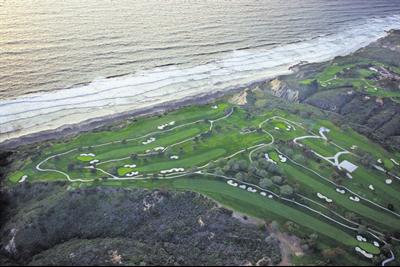
In his acceptance speech after winning the Players Championship last month, Sergio Garcia said: "First of all, I want to thank Tiger for not being here. That always makes things a little bit easier." World No1 Woods skipped the Players following surgery on his left knee. But he is confident of being around when the US Open, the second major of the season, starts at Torrey Pines in San Diego, next week. And if his reputation and history in majors wasn't enough, on a golf course where he has a phenomenal record – six wins in his last 11 appearances, including wins in his last four starts, course record of 62, and top-10 finish every time he has teed up – Woods will start as favourite even if he is playing on one leg. Agreed, all of Tiger's wins at Torrey Pines have come in the PGA Tour's Buick Invitational, where the course set-up is as different from United States Golf Association's US Open set-up as a walk in Safa Park and Jurassic Park. You can rest assured the rough will be as tall as a tropical rain forest and the greens will be slicker and faster than a billiards table. At 7,643 yards, Torrey Pines will be the longest in major championship history. However, Mike Davis, USGA's man responsible for the course set-up, said it probably would never play its full yardage. His reason: it will become too tough for the players. The par-5 13th hole has three tees that make it play 614, 599 or 539 yards. But if the hole is played at 614 yards, a shift in wind would leave players with a 250-yard carry into the wind to reach the fairway. "I can promise you this golf course could be set up significantly harder," Davis said. "In theory, we can get this exactly how we want it. "But we really want to show the players' skills. We saw too many examples at Oakmont and Winged Foot that guys were just chopping out of the rough. That's not what we wanted. "I think we came this year knowing that Torrey is going to be a long golf course, knowing that it's going to be firm. If we're going to err on the first cut, we're going to err because it was too short." Davis thus ordered the first cut of rough to be brought down to 2.5 inches – something one rarely gets to see at a US Open. And Davis agrees: "That's low rough. You look back in the history of the US Open, and this almost doesn't look like US Open rough." But this is what Davis has in store for players – four inches and more of kikuya rough that could seriously damage the wrist if someone tries to become a hero, and greens which will be in excess of 13 on the stimpmeter. Despite the length of the course, Davis was most excited about the shortest par-3 hole in the last eight US Opens. The 195-yard third hole, with the Pacific Ocean as a backdrop, requires a long or medium iron down the hill into a breeze to a green that is protected by a bunker in the front. Anything long or left falls off the cliffs into a hazard. Davis said it reminded him of the famous 107-yard seventh hole of Pebble Beach, and reckons he has found a tee from 142 yards that might make it even tougher. Even though most players would possibly use a sand wedge, they will struggle to get the right distance and trajectory. World No2 Phil Mickelson, a San Diego native for whom the Torrey Pines is like a home course, said despite Davis' comments and intentions, it may still turn out to be the toughest US Open ever. Mickelson said he did not think anyone will come remotely close to matching par, adding: "I think it's the hardest course in the world, 7,600 yards at sea level. There are no bail out on any hole, bunkers are left and right, pins are tucked, and there's no letup; there's no easy par 4s. Par 5s for the US Open are going to be long and almost impossible to reach. "Even if it's soft, I don't think anything close to even par will win. I recently played there with two very good amateurs, both former national-level golfers, and each shot about 85 for a best ball score of 80. That's how hard it is." Woods, who missed his only cut as a professional in the 2006 US Open at Winged Foot when he was making a comeback after the death of his father, refused to draw any parallels with his recent rehabilitation layoff as he spoke about the challenges posed by Torrey Pines. "That [2006 US Open] was a totally different mental situation than I am now," Woods said. "Even when I came back for the Open, I probably wasn't ready to play yet. I was eager to get back and play and be in a competitive environment, but I wasn't ready to deal with all the things you have to deal with inside the ropes. And it showed, and I played terrible. "This time around, it's totally different. Everything in my life is doing great. I'm just trying to get the leg organised enough to where I can play. If I can't play before, possibly at the Memorial, then hopefully, I will be all right at the Open." As for what would be required to do well at the US Open, Woods said: "This is a course, especially after the redesign, where you need to be a shot-make