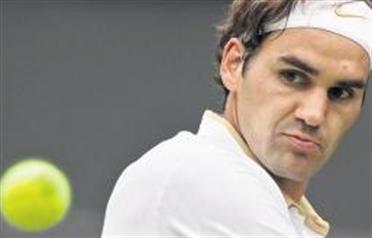
Had Rafael Nadal terrorised tennis stars of a bygone era, Roger Federer would probably list the Spaniard as one of his sporting heroes. Instead, the Swiss grew up watching Boris Becker and Stefan Edberg battle it out on the grass courts of Wimbledon, before Pete Sampras rode into SW19 in the 1990s and left clutching a bagful of championship trophies. "It's really nice to have idols and heroes growing up," Federer tells Emirates Business. "It's an inspiration to be able to look at what the greats do and follow them. Especially the attitude; the winning mentality they bring to the court and, of course, the intrigue and the gamesmanship are really important assets as well." The facets that have smashed the men's game into another stratosphere will be lacking somewhat when the competition enters its crucial second week on Sunday. Federer's rivalry with Nadal, beautifully illustrated in last year's epic final, has become the main talking point of the sport, but the reigning champion's knee injury forced his withdrawal from the tournament before the first shot was struck. Federer has since stated his disappointment at not being able to replicate last year's showpiece – the greatest witnessed at SW19 – so he must satisfy himself with mulling over his dream final, from players past or present. "There's so many [to choose]," he says, laughing. "The first that comes to mind is Bjorn Borg, because I was able to equal his five wins there, and the next would be Pete Sampras because he won seven. "I was lucky enough to play him at Wimbledon once, in a five-set thriller [in 2001] which was incredible; my first Centre-Court appearance. But that wasn't a final." Although Sampras will be watching this year's tournament from his Atlanta home – he retired in 2002 – the 14-time Grand Slam winner will creep more into Federer's thoughts with every opponent vanquished on the lawns of the All England Club: a win would see Fed Express surpass Pistol Pete as the greatest major title winner in history. The suggestion Federer would register such an achievement seemed implausible only a few months ago. The former world No1 had lost his place at the top of the ATP rankings – 237 consecutive weeks halted by a bulldozing Nadal last August – and was reduced to tears by his Spanish conqueror at the Australian Open in February. "It's killing me," wept Federer at Rod Laver Arena afterwards. In Miami in April, when he uncharacteristically smashed his racquet to the ground after a poor forehand error against Novak Djokovic, critics closed in on the star. He had lost his cool, they said. John McEnroe claimed nerves were getting the better of him against the top players. In contrast, Nadal was growing stronger by the week and seemed unstoppable. The Majorcan-born baseliner gathered another four titles before Federer could win again, but his straight-sets victory against Nadal in the final of the Madrid Open last month marked a shift in attitude: Federer was not finished. "A positive mindset is something that's kept me happy as a person," says Federer, who has amassed $48 million (Dh176m) in career earnings. "You can't win all the time. When there's a downside there's always a positive side as well. "It doesn't matter how bad a situation I'm in, not just on the tennis court when I've lost a match, but especially in life, I always see the positive side after that. I can go on the practice courts and work on my weaknesses instead of going out to focus on my strengths, which at the end of the day are what actually pays my bills. "Instead of working on my forehand and working on my serve, which win me matches, I concentrate on shots I almost never get, trying to perfect those. It's very much my real philosophy." The perfectionist in Federer is what makes him such a great champion. An undoubted star on court, he is also a gentleman off it. Born in Binningen, near Basel, the 27-year-old speaks four languages fluently – Swiss-German, German, French and English – and can be found conducting press conferences in any of the above. His skills have transported him across the ATP circuit during the past 11 years, from Miami to Melbourne, Dusseldorf to Dubai, where he lives for three months of winter training every year. Switzerland, however, is still very much where the heart is. "I have a South African mother and a Swiss father, but I still feel Swiss on the court," explains Federer. "I was born there; I grew up there; all my friends and family are there, so it's the place I call home and it's where I want to grow old. "It's a wonderful place – full of mountains and lakes and the people are very friendly and open because they speak three or four languages. It's something I'm actually very fortunate to carry through on to the world tennis tour. "We've seen in the past many top players can only speak one or two languages, where I have this great advantage of speaking many more and I think that's why people consider me one of the greatest ambassadors, not just f