Qatar banks stay attractive for investment
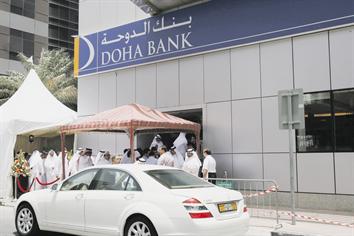
Attractive valuations in spite of a strong recent shape-price performance and continuing government spending make Qatar's banks good investment prospects, Credit Suisse said in a research repport released yesterday.
"Current valuations are still attractive on both a relative basis (trading at a record discount to their Saudi and Kuwaiti peers) and on historical multiples (trading at 50–82 per cent below their historical P/B averages)," the report said.
"With estimated real GDP growth of 6.3 per cent in 2009, Qatar's economy remains one of the fastest growing in the world. This is compared with contracting global GDP (-1.1 per cent; 2009E) and flattish to negative real growth of the Emea and GCC economies."
Qatari banks have one of the lowest gearing ratios in the world at 6.9 times at the end of Q1-2009. They also boast some of the world's highest capitalisation ratios, with Tier 1 capital at 15.2 per cent. Profitability and efficiency are also high – return on assets in 2008 was 3.6 per cent. This year's estimated cost to income ratio is expected to be 27 per cent, Credit Suisse said.
"They enjoy the lowest non-performing loans (1.1 per cent in 2008) in emerging markets (3.5 per cent average), have lower risk of mark-to-market write-downs owing to the sale of local securities to the government and minimal short-term refinancing risk with only $380 million (Dh1.39bn) maturing in 2009," the report said, using three banks as a basis of its calculations.
The investment report has also initiated Commercial Bank of Qatar, Qatar National Bank and Doha Bank at "outperform" ratings.
The Qatar Government's offer in December to buy up to a 20 per cent equity stake in all local banks to boost capitalisation demonstrated "substantial government support" for the sector, it said. The support also came in the form of the government absorbing more than QR1.5bn of trading losses incurred by local banks following the 36.2 per cent drop in the Doha stock index from January 1 to March 8.
Exposure to the real estate market, however, could prove to be a challenge, Credit Suisse said.
Although the three banks' loan book exposure to real estate and construction is relatively moderate compared with global and regional peers, the variation among the three is high, it said, with QNB at only 13 per cent while CBQ and DBQ are at about 27 per cent each.
Real estate prices have declined 23.4 per cent from a peak in Q3-2008 to Q1-2009.
"However, key safeguards are: the 65 per cent loan-to-value limit enforced by the central bank in March 2008, keeping the vast majority of investors in positive equity and thus limiting the incentive to default to only QR1.3bn; and the government's offer on May 28 to buy $4.1bn worth of real estate portfolios.
"We estimate a significant deceleration in balance-sheet growth in the next four years to an eight per cent CAGR, down from a 44.9 per cent CAGR in 2004–2008. Cost pressure is likely to increase given that cost efficiency is only sustainable at high balance-sheet growth," Credit Suisse said.
More interestingly, on a trailing P/B basis, the three Qatari banks are trading at a record 40 per cent discount to Saudi banks versus a historical average discount of 20 per cent, and at a 24 per cent discount to Kuwaiti banks versus a historical premium of 14 per cent, the report said.
"While we think Saudi banks deserve to trade at a premium to their peers owing to their superior asset quality, lower banking sector penetration and exposure to a relatively more diversified economy, we think current valuations are full. However, the current discount of Qatari banks to Kuwaiti banks is not justified in our view given the latter's significant asset quality deterioration (NPL ratio of 6.85 per cent in 2008)," the report said.
Keep up with the latest business news from the region with the daily Emirates Business 24|7 newsletter. To subscribe to the newsletter, please click here.