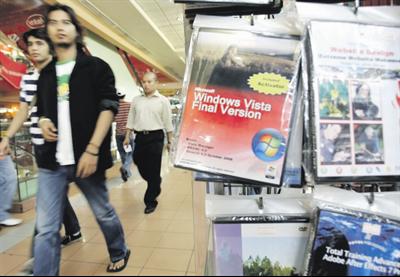
The UAE must overcome a series of challenges as it seeks to transform itself into a leading global commercial hub over the next 10 years. Rising inflation, a lack of skills and shortages of materials – to name a few – are considered major obstacles to the sustainable development of the country. And in the past few months another threat has grown more apparent as software piracy has increased to a level that is alarming local authorities. The UAE leads the region in anti-piracy practices – yet industry estimates show that 35 per cent of software sold in the UAE is counterfeit. International estimates are higher at 38 per cent. Losses arising from the problem rose to $94 million (Dh345m) in the UAE in 2007 – a 52 per cent increase on the previous year's figure of $62m, according to the annual survey conducted jointly by the Business Software Alliance (BSA) and global market research firm IDC. Software piracy in the Middle East and Africa region cost $2.45 billion in 2007 – a 24 per cent increase from 2006 levels. Gulf countries lost $400m in 2007, 3.09 per cent up from the 2006 figure of from $388m. Globally, losses to piracy in 2007 totalled nearly $48bn, an increase of $8bn over the previous year. Before last year international piracy had been relatively stable, standing at 36 per cent in 2003 and remained at 35 per cent for the next three years. Last week the Ministry of Interior announced that arrests for software piracy had jumped by 107 per cent over the past year – though they did not say how many people had been held. In February Abu Dhabi police raided three information technology resellers and seized 93 CDs containing pirated Microsoft programmes. Such moves, however, only scratch the surface as software piracy remains the hardest crime to detect. "Software piracy is the easiest type of piracy because software is not tangible," Ahmad Al Jasim, regional manager of Autodesk Middle East, told Emirates Business . Autodesk – maker of design software AutoCAD – has been reeling from a 55 per cent piracy rate. "Software is usually on a CD and because a company's knowledge is on this small storage device people can actually easily pirate it. The fakes come in mass volume, primarily from East Asia." China is the largest producer of pirated products in the world – and software is no exception. The BSA estimates that 82 per cent of the PC software used in China in 2006 was pirated. After joining the World Trade Organisation (WTO) China adjusted its laws to comply with the WTO Agreement on Trade-Related Aspects of Intellectual Property Rights (TRIPS). So the laws are in place – but are being ignored. Al Jasim said: "Piracy is a major threat as we are losing Dh50m a year – the piracy rate for our products is 20 per cent higher than the UAE average because we have more expensive software. "We have a standard approach to deal with this. First we identify if a user has legal or illegal software because, both ways, we consider them to be our customers. "We as authorised distributors can recognise our customers because we have the serial numbers. "If a customer is not using legal software we call him and let him know that. Sometimes the business owner is unaware. If he does not respond to our courtesy call then we issue warning letters. And if he still does not comply we move on to the legal process. We have already filed one legal action and three more are in the pipeline," he said. Al Jasim said piracy rates were even higher in Kuwait, Egypt, Jordan and Lebanon. Information technology experts forecast that, despite aggressive anti-piracy campaigns, the volume of counterfeiting will continue to grow in tandem with the burgeoning IT sector. "Even if you catch some there's still more new pirates coming in every year," added Al Jasim. "Then you try to catch them – it's a continuous cycle." The latest Global Software Piracy Study by BSA and IDC indicates the problem has increased largely because of the unprecedented growth of the IT industry in areas where there are no committed efforts to control piracy, said Jawad Al Redha, BSA co-chairman for the Gulf. "The spread of the internet has contributed to the current situation as access to pirated software has moved from the streets to the web," Al Redha added. According to IDC, the UAE's IT investment is set to soar by 20 per cent this year, buoyed by a strong economy and the influx of investment in various sectors. This means Dh12bn to Dh13bn will be shelled out for hardware, software and IT services in the country – up from Dh10.3bn last year. Jyoti Lalchandani, vice-president and regional managing director for IDC Middle East and Africa, said: "The mood is very positive as we see continued growth in this region." And, despite the economic slowdown in the United States, he said spending on software was not expected to drop – though companies would be cautious. "Everybody in the world has been afraid of the slowing down of the US market," Lalchandani said. "The good news