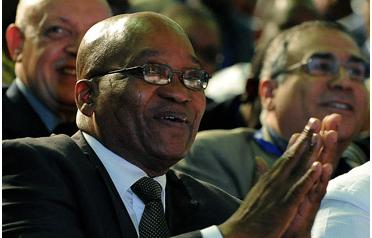
South Africa's ruling ANC won its first outright majority in KwaZulu-Natal, party boss Jacob Zuma's home province, in a turnaround for a region that saw gruesome inter-party attacks during the last days of apartheid. The African National Congress took 63 per cent of the provincial vote, up from 47 per cent five years ago, allowing it to govern the Zulu stronghold without a coalition partner for the first time. The Inkatha Freedom Party (IFP), which has steadily leaked support since the country's first democratic polls in 1994, took only 22 per cent despite once dominating the political landscape of the coastal province. Its fate on the national ballot was even worse. After 15 years as the third-largest party in parliament, the IFP was upstaged by newcomers the Congress of the People, which broke away from the ANC just five months ago. Zuma played a key role in persuading his fellow Zulus that they should join the new democracy, arguing that South Africa's future would be political and not ethnic. Some 12,000 people were killed in KwaZulu-Natal in political clashes between the ANC and IFP in the run-up to the 1994 elections, which veteran Zulu leader Mangosutho Buthelezi only agreed to participate in at the last moment. Nelson Mandela, the country's first black president, chose to cast his first ever vote in the province in 1994, saying the country was starting a new era of hope, reconciliation and nation building. The IFP had a number of ministers in the ANC-led government formed after South Africa's first multi-racial elections in 1994, but was muscled out of power in 2004 after suffering a meltdown among its supporters. The province for years was regarded as a hotspot for political violence, and this year again saw several reports of pre-election clashes in the province but no large-scale unrest. The ANC intently brushes off any ethnic factor in the vote, saying it was just cashing in on the IFP's implosion. "Ethnicity had nothing to do with the large voter turnout," said senior ANC leader Jeff Radebe. "The ANC is for everyone and we are strongly opposed to any divisive ethic talk or speculation." "The IFP is losing political ground, so we capitalised on that," he said. Political analyst Sipho Seepe said the ANC's success in the province had more to do with Zuma's hometown connections than with his ethnicity. "People associated with him, not because of his ethnicity but for the mere fact that he is the local," Seepe said. "What we saw in KwaZulu Natal was a classic example of the power of mobilisation at grass root level," said Seepe. However, analyst Dirk Kotze said Zuma who is set to be the country's first Zulu head of state will have to present himself as a president of all South Africans to dismiss any perceptions of ethnic favouritism. "One of the priorities for him to address is to present himself as a national figure and not one located within KwaZulu-Natal," he said. Head of the ANC election campaign Fikile Mbalula told AFP that the party's clean sweep in KwaZulu-Natal spelt the death of the IFP, despite it once holding a pivotal role in South Africa's transition to democracy. Results in the province showed that voters had identified with the ANC's policies, he said. "It was important for us that Zuma gets the support of his home people, it's got nothing to do with his Zuluness," said Mbalula. Keep up with the latest business news from the region with the Emirates Business 24|7 daily newsletter. To subscribe to the newsletter, please click here .