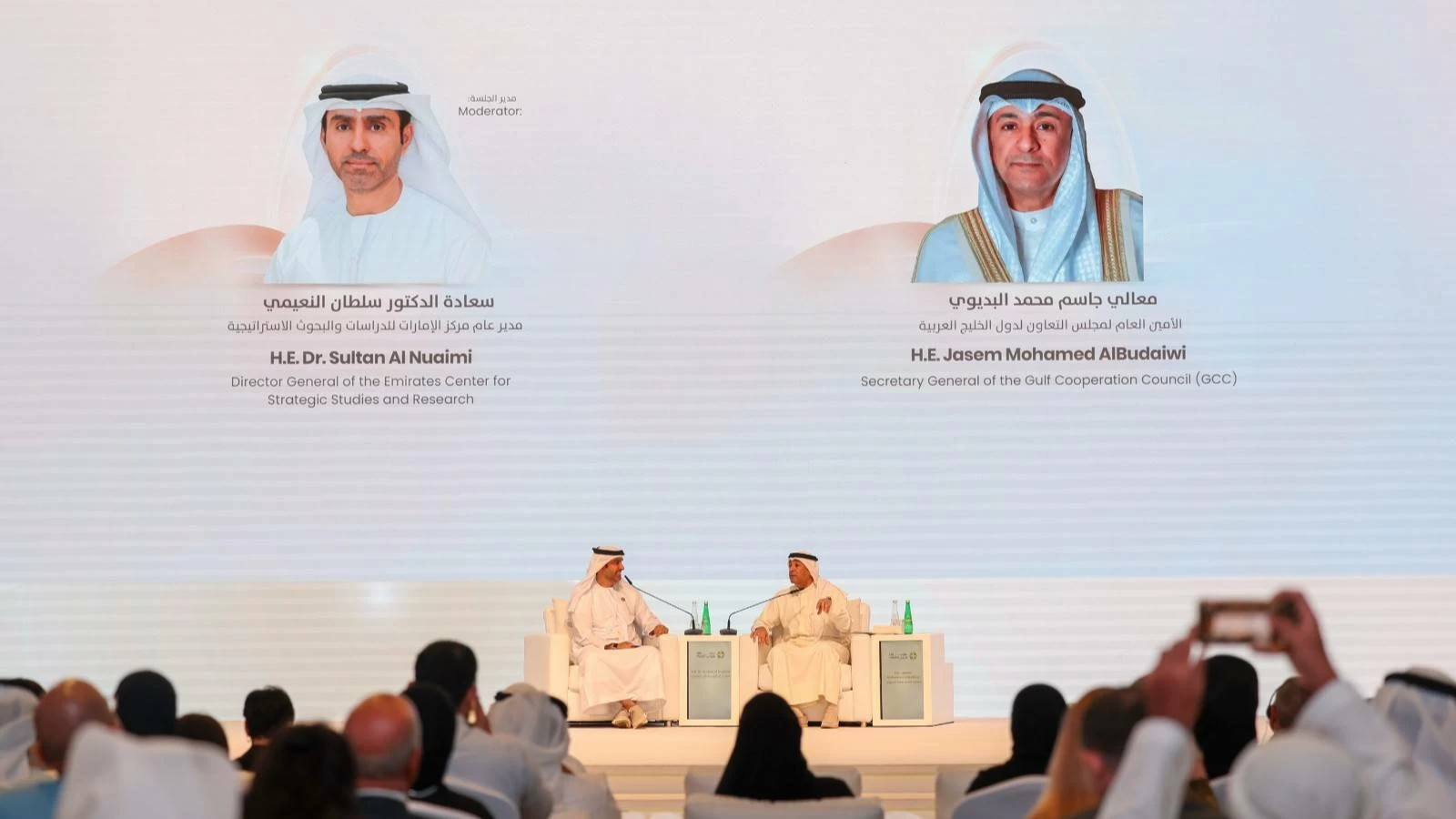
Jasem AlBudaiwi says attacks on Gulf states reshaped regional security priorities
Hili Forum session highlights unprecedented Gulf coordination, new regional security initiatives and the future of relations with Iran

Abu Dhbai: The first day of the third edition of Hili Forum 2026 concluded with a dialogue session featuring His Excellency Jasem Mohammed AlBudaiwi, Secretary-General of the Gulf Cooperation Council (GCC), moderated by Dr Sultan Mohammed Al Nuaimi, Director-General of the Emirates Center for Strategic Studies and Research (ECSSR).
The discussion focused on the aftermath of the attacks targeting GCC countries, their impact on joint Gulf action, and the future of relations with Iran.
AlBudaiwi described the period following the attacks as having produced an unprecedented level of coordination among GCC member states, extending across military, economic, security, health, administrative, water and electricity sectors.
He said the response strengthened Gulf integration and demonstrated the ability of GCC countries to work collectively under pressure.
As an example, AlBudaiwi cited the disruption to navigation through the Strait of Hormuz, which created logistical challenges for Bahrain, Qatar and Kuwait. He said the UAE, Saudi Arabia and Oman responded by opening ports and terminals, dispatching trucks and temporarily suspending regulations that could have disrupted the movement of goods.
According to AlBudaiwi, the experience demonstrated that Gulf integration can function effectively during times of crisis.
New Gulf initiatives
AlBudaiwi said the extraordinary GCC consultative meeting held in Jeddah on 28 April produced a number of decisions based on lessons learned from recent developments.
Among the initiatives under study are:
Enhancing joint logistical support and alternative transport corridors.
Establishing water interconnection projects between GCC states.
Developing strategic storage systems allowing member states to store reserves in neighbouring countries.
Identifying alternatives for oil and gas pipeline routes.
Increasing the capacity of the GCC electricity grid.
He said implementation and study phases of these initiatives have reached completion levels ranging between 50 and 70 per cent, with more than 50 ministerial committees involved in the work.
International support
Addressing international reactions to the crisis, AlBudaiwi said GCC engagement extended through a series of extraordinary ministerial meetings with the European Union, the United States, the United Kingdom, Egypt, Jordan and Morocco, alongside bilateral consultations.
He rejected suggestions that international partners had waited for the conflict to end before engaging, saying GCC countries received support, offers of assistance and information-sharing from multiple partners, including several European states.
Relations with Iran
Discussing relations with Iran, AlBudaiwi highlighted what he described as the contrast between Iran's size and resources and its economic performance.
He said Iran remains a neighbour with whom engagement is unavoidable and noted that GCC states have repeatedly communicated their concerns to Tehran, including during the first GCC-Iran ministerial meeting held in October 2014.
According to AlBudaiwi, GCC states sought to address challenges in the relationship while exploring potential areas of cooperation, but the trust-building measures required to advance relations were not adopted.
He said recent attacks had returned relations to "square one", adding that GCC states had consistently advocated de-escalation and sought to prevent military confrontation.
"The ball is now in Iran's court," he said, adding that Tehran must take steps demonstrating goodwill towards both GCC countries and the international community.
When asked about dialogue with Iran amid differing centres of influence within the country, AlBudaiwi said this was an internal Iranian matter and stressed that what matters to GCC states are actions and outcomes.
He said any future negotiations should involve representatives capable of making commitments and implementing agreements.
Strait of Hormuz
AlBudaiwi also warned against the internationalisation of regional waterways, including the Strait of Hormuz.
He said international law already provides a framework for regulating maritime navigation and argued that the focus should be on enforcing existing rules rather than creating new arrangements.
Message to the world
Concluding the session, AlBudaiwi said the GCC wished to send a clear message through the forum:
"The Gulf is a reliable partner at all levels, tried and tested. Its credibility and performance speak for themselves, and it keeps its word."
He pointed to foreign investments in GCC countries totalling approximately $792 billion as evidence of international confidence in the region.
AlBudaiwi also described the Gulf's greatest asset as its young people, attributing the region's achievements to the vision of both its founding leaders and current leadership.