
Astronomers watch the whole process as a huge star 30 times the size of sun dies
Massive Wolf-Rayet star explodes into a broad-lined Type Ic supernova, revealing new clues about stellar deaths, black hole formation, and why some blasts lack gamma-ray bursts
 Reuters
4 min read
Share
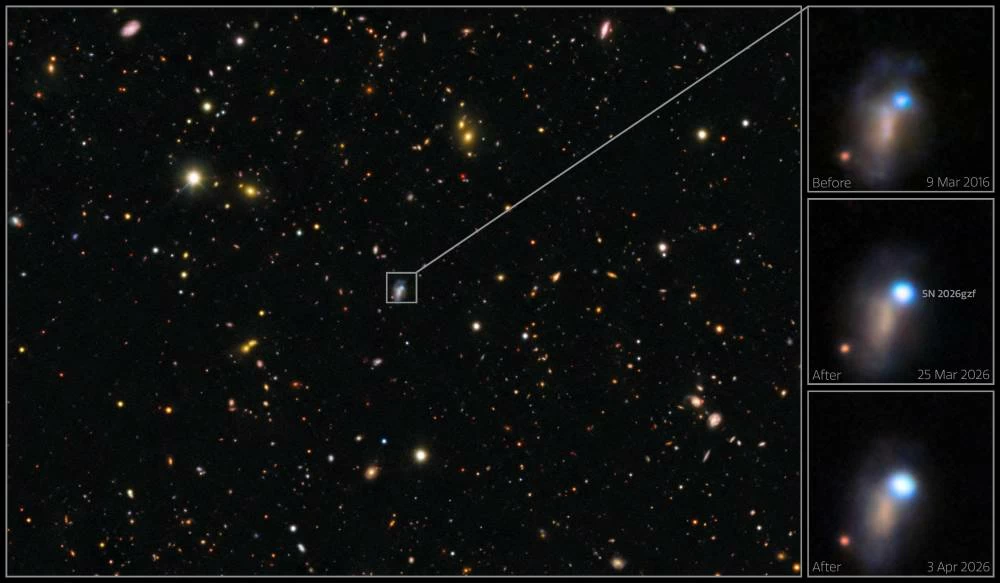
A combination of images show the evolution of supernova SN 2026gzf, which was first detected by the Einstein Probe on March 21, 2026. Images taken on March 25 and April 3, 2026, show the supernova brightening. An archival image of the host galaxy from March 9, 2016, reveals a bright blue source at the location of the supernova, which scientists say likely represents a compact, extreme star-forming region in the host galaxy, combined with pre-explosion activity of the star before its death. (Reuters)
Add Emirates 24|7 to your Google News
Text Size:
