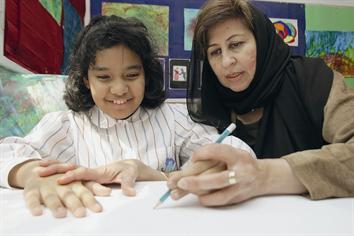
Community groups in the UAE say they have suffered some of the worst effects of the global downturn with vital contributions through corporate social responsibility programmes dropping by 70 per cent. Companies hit by the ongoing global financial downturn have restructured their operations, often excluding CSR programmes completely. In turn, reduced budgets have forced social organisations to cut down on skilled staff, which is seriously threatening their work and leaving people in need, Emirates Business has learned. A lack of funding is, however, pushing elements of the private sector to realign themselves with different fundamentals of CSR, which had been purely philanthropic until the crisis hit. Mohammad Al Emadi, Director General and Board Member of the Dubai Autism Centre, said: "From mid 2008 to nearly the end of last year, the support was tremendously high. "[Companies] were conducting their corporate social responsibility at a higher standard. Unfortunately, with the crisis, a lot of people have withdrawn support. "This year we have struggled – not many have come forward to fund services for children with autism, who need professional support for which we need trained professionals. Funding has dropped 70 to 75 per cent," he said. The centre has been struggling to raise funds to help it hire seven professional therapists and fill an additional three management posts. International organisations are suffering the same fate, said Ivano Iannelli, former head of operations for the United Nations Office for Project Services (Unops) in the region. Late last year, plummeting government contributions lead Unops to close its Dubai-based centre, which worked with the greater Mena region. "Our portfolio of $1.4 billion (Dh5.1bn), of which a fourth was from this region, dropped to $400 million to $500m," said Iannelli. "Our sponsoring bodies are big governments who contribute funds through bilateral co-operation. Since Unops only executes projects once the funds are in, those projects have not been affected. However, the number of new projects has obviously come to a virtual stand still," said Iannelli, now a CSR and sustainability consultant. James Hartnell, Director of Marketing at environment group Bee'ah said his experience had shown that many CSR programmes in the region were charity or religion-based. And these were normally carried out by donations from staff with company contributions, or purely corporate donations. He said:?"It would be logical that given the current economic climate, activities would reduce to some degree. "At Bee'ah, we are in the process of creating CSR programmes for corporations and industries in Sharjah that only ask for a small amount of people's time and some commitment from the organisation. "They will be environmentally focused and will have huge benefits for the local communities in which they operate and where their staff and families work and live. "They won't rely on financial input allowing companies that are feeling the pinch to still contribute in a socially beneficial manner." Companies in the process of restructuring due to the crisis have begun to adopt CSR and are keen to cash in before the CSR is made mandatory. Iannelli's CSR consultancy firm, Istidama, reported a sharp rise – from seven to 32 – in the number of companies adopting best CSR practices post crisis. "From where we stand it has become a golden opportunity to restructure companies and everybody needs, not wants, to integrate environmental and social dimensions in their balance sheet," he said. "They know that these will become a cost at some point so they would rather get the knowledge into the organisation now rather than later. "Pre-crisis there was so much capital surplus that CSR was a synonym of philanthropy. Now they are grasping the concept that CSR means investing to receive something back." Major Ali, of the Emirates Marine Environment Group, said the organisation had to reduce staff due to a fall in financial donations. "Our projects have stayed on course, but with less money and less professional help we are having half the effect on helping our environment. It will be the same everywhere. These are severe times," said Al Emadi. "Imagine not feeling well and not having the right doctors to treat you. This should not be the case. Some companies have completely withdrawn funds for 2009. And personally, I don't think all of them have been affected so badly, so we should be seeing more funds," he said. "I would like to see the government make it mandatory for companies to be involved in CSR activities. Five per cent of their annual profit should go into a CSR fund regulated or controlled by a government authority." Lola Lopez, founder and CEO of Aid in Motion and Volunteer in Dubai and Abu Dhabi, called for a rethink of the way charities are run and CSR and philanthropy is conducted in the region. "Charities have been mollycoddled way too long. Now money is coming in at a slower rate and they